 Rustango
 URL names & reverse
Hardcoding URLs (/posts/42) all over handlers and templates is fragile — change
a route and every literal breaks silently. Rustango gives you Django's
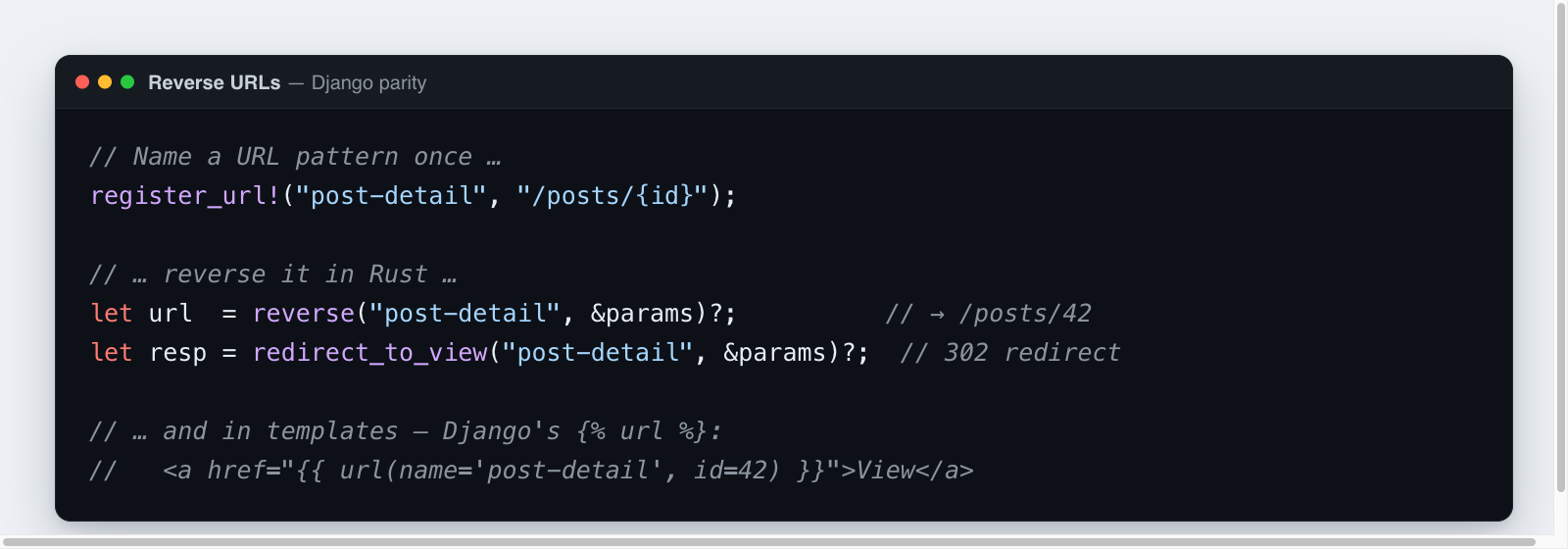
answer: name a URL pattern once, then build the URL by name everywhere — in
Rust with reverse(...), in templates with {{ url(...) }}, and in redirects
with redirect_to_view(...). The API surface mirrors Django's
reverse() / {% url %} / resolve_url() / redirect().
Source:
rustango::urls(register_url!,reverse,reverse_owned,all_routes,duplicates,register_url_tag) andrustango::shortcuts(resolve_url,redirect_to_view).
New to a term here? route, reverse, namespacing — see the glossary.
Table of contents
- Register a named URL
- Reverse in Rust · Reverse in templates
- Redirect by name · Namespacing
- Inspect the URL map · Errors
- Regex & typed path patterns · Notes & limits
Register a named URL
register_url!("name", "/pattern") registers a name → pattern mapping. It runs
at module-load time (via inventory), so the route lands in a global registry
the moment its module is linked — no central urls.py to edit, and no
include() to wire up.
use rustango::register_url;

register_url!("post-detail", "/posts/{id}");
register_url!("user-posts",  "/users/{user_id}/posts/{post_id}");
register_url!("home",        "/");
Placeholders use axum's {name} path syntax. The pattern is the same string you
mount the handler at — keep them in sync (register the name next to where you
build the route).
Reverse in Rust
reverse(name, ¶ms) substitutes the pattern's {placeholders} with the
given values (percent-encoding each) and returns the URL:
use std::collections::HashMap;
use rustango::urls::reverse;
let mut params = HashMap::new();
params.insert("id", "42".to_string());
let url = reverse("post-detail", ¶ms)?; // → "/posts/42"
For dynamic keys (e.g. values assembled from a request), reverse_owned takes
HashMap<String, String> instead of HashMap<&str, String>:
use rustango::urls::reverse_owned;
let url = reverse_owned("post-detail", &owned_params)?;
reverse is strict: a missing placeholder, or an extra params key that
the pattern doesn't have, is an error (not a silent mismatch) — see
Errors.
Reverse in templates
Templates get Django's {% url %} as a Tera function. Register it once on your
Tera instance at setup (it's behind the template_views feature):
rustango::urls::register_url_tag(&mut tera);
Then call url(name=..., <param>=...) in any template — name is required, and
every other keyword argument is a path parameter (strings, numbers and bools are
accepted):
<a href="{{ url(name='post-detail', id=42) }}">View post</a>
<a href="{{ url(name='user-posts', user_id=7, post_id=42) }}">…</a>
That's the equivalent of Django's {% url 'post-detail' id=42 %}. For the
{% url 'x' as var %} capture pattern, use Tera's {% set %}:
{% set post_url = url(name='post-detail', id=post.id) %}
<a href="{{ post_url }}">{{ post.title }}</a>
A null argument (usually an undefined template variable) errors loudly rather
than silently producing a broken URL.
Redirect by name
rustango::shortcuts mirrors Django's view-name redirect helpers, so handlers
never hardcode a Location:
use std::collections::HashMap;
use rustango::shortcuts::{redirect_to_view, resolve_url};
// redirect('post-detail', id=42) → 302 Location: /posts/42
let mut params = HashMap::new();
params.insert("id", "42".to_string());
let response = redirect_to_view("post-detail", ¶ms)?;
resolve_url(spec, ¶ms) is Django's resolve_url: if spec already looks
like a URL (/…, http://, https://, ./, ../) it's returned unchanged;
otherwise it's treated as a route name and reverse-resolved. Handy for a
?next= parameter or a setting that may hold either a path or a name:
let url = resolve_url("post-detail", ¶ms)?; // name → "/posts/42"
let url = resolve_url("/dashboard", ¶ms)?; // path → "/dashboard" (as-is)
(For raw redirects to a known URL, rustango::shortcuts::redirect(url) returns a
plain 302.)
Namespacing
There's no include() and no auto-applied app namespace — every register_url!
lands in one global registry. Namespacing is a convention in the name itself:
prefix with app:, exactly as you'd call Django's reverse("app:detail").
register_url!("blog:post-detail", "/blog/posts/{id}");
register_url!("shop:product",     "/shop/products/{slug}");
reverse("blog:post-detail", ¶ms)?; // "/blog/posts/42"
The colon is just part of the registered string — pick a consistent prefix per app to avoid collisions.
Inspect the URL map
List every registered route from the CLI — useful for a quick audit or to script against:
cargo run -- showurls                  # plain table of name → pattern
cargo run -- showurls --format json    # machine-readable
In code, all_routes() returns the whole registry, and duplicates() returns
any name registered more than once (first-wins otherwise — worth asserting at
boot):
use rustango::urls::{all_routes, duplicates};

for route in all_routes() {
    println!("{} → {}", route.name, route.pattern);
}

let dups = duplicates();
assert!(dups.is_empty(), "duplicate URL names: {dups:?}");
Errors
reverse / reverse_owned / resolve_url / redirect_to_view return
Result<_, rustango::urls::ReverseError>:
| Variant | When |
|---|---|
UnknownName(name) | No register_url! ran for that name (typo, or its module wasn't linked). |
MissingParam { name, param } | The pattern has {param} but params didn't supply it. |
UnexpectedParam { name, param } | params carried a key the pattern doesn't have (catches typos). |
MalformedPattern { name, detail } | The registered pattern is malformed (e.g. an unclosed {). |
In templates these surface as Tera render errors (a 500 via
shortcuts::render / template_views), so a bad {{ url(...) }} fails visibly
rather than rendering a broken link.
Regex & typed path patterns
Rustango has no re_path, and no path converter is ever enforced. A pattern
segment is either a literal (/posts/new) or a {name} placeholder that captures
exactly one segment; {*name} captures the rest of the path. That's the whole
vocabulary — there is no r'(?P<year>[0-9]{4})', and {int:id} does not
constrain id to an integer.
Why — the matcher isn't a regex engine
Routing is axum 0.8, and axum matches paths with
matchit, a radix-trie router. It walks the URL
one segment at a time down a prefix tree, so a match costs O(path length) and is
independent of how many routes you've registered. A regex router does the
opposite: Django evaluates urlpatterns top-to-bottom, running each entry's
regex against the path until one matches. The trie buys constant-time matching
and an unambiguous "most-specific literal wins" precedence — at the cost of not
expressing character-class constraints in the path itself.
Rustango inherits that matcher wholesale. There is no second, regex-based
resolver layered on top, and register_url! deliberately records the same
{name} strings the router already understands — it never compiles a regex. So
regex paths aren't "turned off"; the routing layer was simply never a regex
engine to begin with.
The {int:id} form is accepted only as a porting affordance for reverse():
the builder splits the placeholder on : and keeps just the name, discarding the
type prefix (urls.rs). That lets reverse()
run on a pattern copied verbatim from a Django path("<int:id>/", …) — but
nothing validates that the supplied value is actually an integer.
How to express a constrained route
Match the segment with a plain {placeholder}, then enforce its shape where the
value is used. Django's re_path(r'^articles/(?P<year>[0-9]{4})/$', …) becomes:
register_url!("article-by-year", "/articles/{year}");
// router:
.route("/articles/{year}", get(article_by_year))

async fn article_by_year(Path(year): Path<String>) -> impl IntoResponse {
    // the router accepted any single segment; enforce [0-9]{4} here
    match year.parse::<u16>() {
        Ok(y) if (1000..=9999).contains(&y) => render_year(y).await,
        _ => StatusCode::NOT_FOUND.into_response(),
    }
}
To reject before the handler runs (closer to Django's converter semantics), put
the check in a custom axum extractor (FromRequestParts) and take that type as
the handler argument instead of Path<String> — the framework doesn't ship one,
but axum's extractor trait is the intended seam. The regex crate is already a
dependency (the ORM uses it for __regex lookups), so a validating extractor can
compile a Regex once and reuse it across requests.
Notes and limits
- Registration is link-time. A
register_url!only takes effect if its module is compiled into the binary. AnUnknownNameerror usually means the name is a typo or its module isn't referenced anywhere (so the linker dropped it). - Patterns aren't validated against your real routes.
register_url!records a name → string mapping; it doesn't check that a handler is actually mounted at that pattern. Register the name where you mount the route so they stay in sync. - Values are percent-encoded by
reverse, so they're safe to drop into aLocationheader or anhref. - No regex/typed converters in patterns (Django's
<int:pk>); placeholders are plain{name}and values are substituted as-is (after encoding). See Regex & typed path patterns for why, and how to constrain a route instead.