 Rustango
 Background jobs
Some work shouldn't happen during a request — sending a welcome email, resizing an upload, syncing a third-party API. Doing it inline makes the user wait and couples the response to a flaky external call. A background job moves that work onto a queue: the handler returns immediately, and a pool of workers runs the job moments later, with automatic retries and a dead-letter path for failures. This is Django-Q / Celery / Laravel queues, in Rust.
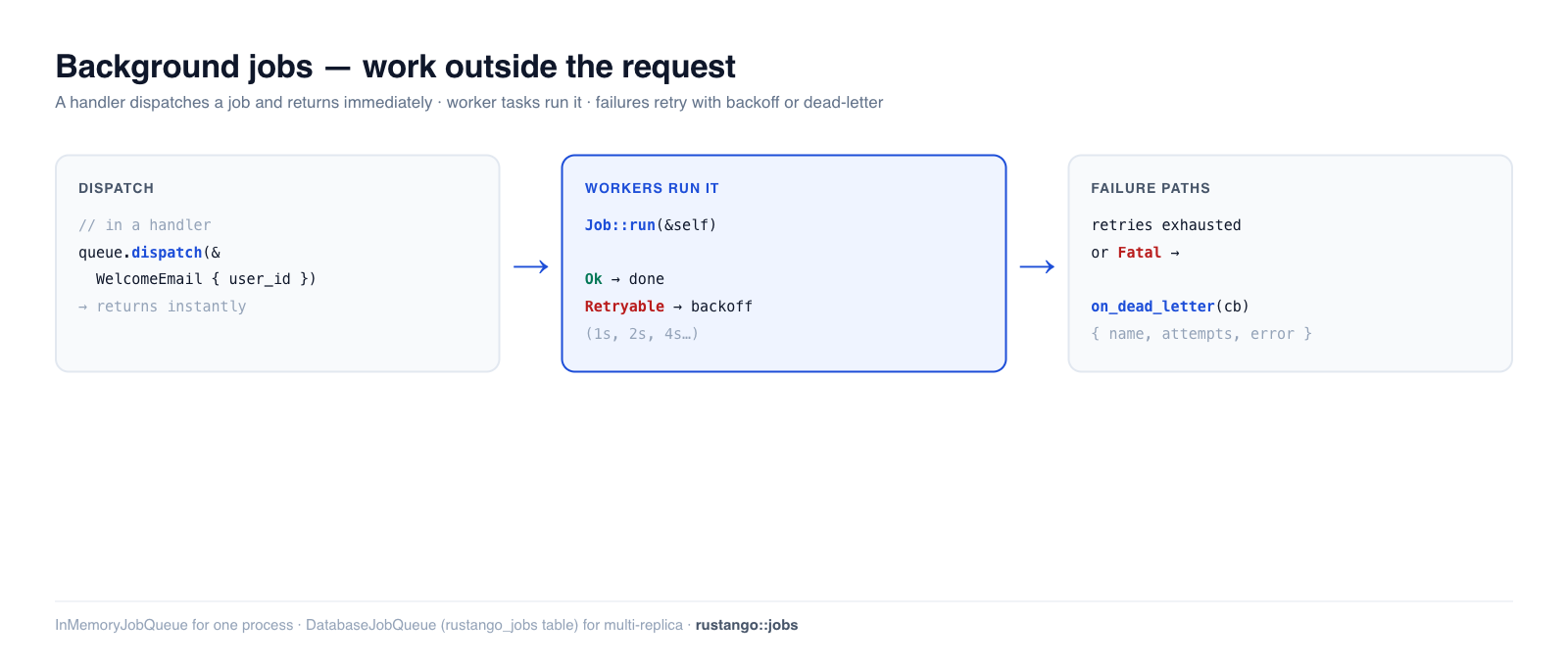
New to a term here? queue, worker, retry/backoff, dead-letter — see the glossary.
Source:
rustango::jobs(Job,JobQueue,InMemoryJobQueue,JobError,JobDeadLetter) andrustango::jobs::DatabaseJobQueue(the table-backed queue, alias ofpg::PgJobQueue) — behind thejobsfeature (on by default).Runnable version: the in-memory, retry, and dead-letter snippets are copied from
jobs_doc.rs(cargo test -p rustango --test jobs_doc); the persistent queue is dogfooded on SQLite byjobs_sqlite_live.rs(cargo test -p rustango --features sqlite,jobs-postgres --test jobs_sqlite_live).
Table of contents
- Step 1 — Define a job
- Step 2 — Start a queue
- Step 3 — Dispatch from a handler
- Step 4 — Wire it into your app — the full example
- Running the workers (CLI + production)
- Retries and backoff
- The dead-letter handler
- The persistent queue (production)
- Reference
- See also
Step 1 — Define a job
A job is a serializable struct that implements Job. The payload is what gets
queued (serialized to JSON); run() is the work. NAME routes a queued payload
back to its handler, so it must be unique.
Scaffold a skeleton with the CLI — cargo run -- make:job WelcomeEmail — or
write it by hand:
use rustango::jobs::{Job, JobError};
use serde::{Deserialize, Serialize};

#[derive(Serialize, Deserialize)]
struct WelcomeEmail {
    user_id: i64,
}

#[async_trait::async_trait]   // add `async-trait` to your Cargo.toml
impl Job for WelcomeEmail {
    const NAME: &'static str = "welcome_email";

    async fn run(&self) -> Result<(), JobError> {
        // ... look up the user and send the email
        Ok(())
    }
}
run() returns:
Ok(())— done.Err(JobError::Retryable(msg))— transient; the worker retries with backoff.Err(JobError::Fatal(msg))— permanent; skip retries, dead-letter it now.
Override const MAX_ATTEMPTS: u32 = 3; on the impl to change the retry ceiling
(default 5).
Step 2 — Start a queue
For a single process (and for dev and tests), InMemoryJobQueue runs jobs on
tokio worker tasks — no database. Register every job type, then start() the
workers (jobs aren't picked up until you do):
use rustango::jobs::{InMemoryJobQueue, JobQueue};
use std::sync::Arc;

let queue = Arc::new(InMemoryJobQueue::with_workers(4));   // 4 worker tasks
queue.register::<WelcomeEmail>().await;                    // before start/dispatch
queue.start().await;

// ... app runs ...

queue.shutdown().await;   // on shutdown: drain in-flight jobs, then stop
Keep the Arc<InMemoryJobQueue> in your app state so handlers can reach it.
In-memory means in-memory. Jobs queued or in-flight are lost on restart. For anything you can't afford to drop, use the persistent queue.
Step 3 — Dispatch from a handler
Once the queue is running, dispatch is one call — it enqueues and returns immediately, so the request doesn't wait for the work:
queue.dispatch(&WelcomeEmail { user_id: 42 }).await?;
A worker picks it up and runs run() moments later. Verified end to end: three
dispatched jobs all run on the workers.
for user_id in 1..=3 {
    queue.dispatch(&WelcomeEmail { user_id }).await.unwrap();
}
// → all three WelcomeEmail::run() calls execute on the worker pool
Step 4 — Wire it into your app
Putting Steps 1–3 together: build the queue and register every job once at
boot, start the workers, hand the queue to your routes so handlers can reach
it, then drain on shutdown. The queue lives in your main.rs:
// src/main.rs
use std::sync::Arc;
use rustango::jobs::{InMemoryJobQueue, JobQueue};
use rustango::manage::Cli;

#[rustango::main]
async fn main() -> Result<(), Box<dyn std::error::Error>> {
    // 1. Build the queue + register every job type BEFORE starting workers.
    let queue = Arc::new(InMemoryJobQueue::with_workers(4));
    queue.register::<WelcomeEmail>().await;
    queue
        .on_dead_letter(|dl| async move {
            tracing::error!(job = dl.name, attempts = dl.attempts, error = %dl.error,
                            "job dead-lettered");
        })
        .await;

    // 2. Start the workers — tokio tasks that run inside THIS process.
    queue.start().await;

    // 3. Share the queue with handlers (axum extension/state).
    let app = urls::api().layer(axum::Extension(queue.clone()));

    // 4. Boot the server. Cli::run() blocks until Ctrl-C / SIGTERM.
    Cli::new().api(app).with_health().run().await?;

    // 5. On shutdown: drain in-flight jobs, then stop.
    queue.shutdown().await;
    Ok(())
}
A handler dispatches by reading the queue back out of the request:
use axum::Extension;
use std::sync::Arc;
use rustango::jobs::{InMemoryJobQueue, JobQueue};

async fn signup(Extension(queue): Extension<Arc<InMemoryJobQueue>>) -> StatusCode {
    // ... create the user ...
    queue.dispatch(&WelcomeEmail { user_id: 42 }).await.ok();  // returns instantly
    StatusCode::CREATED
}
Store the concrete queue type. The
JobQueuetrait is not object-safe (itsregister/dispatchare generic), so you can't holdArc<dyn JobQueue>in state — keep the concreteArc<InMemoryJobQueue>(orArc<DatabaseJobQueue>).
Running the workers (CLI + production)
start() spawns the workers as tokio tasks inside the current process. So
when you launch your app with the CLI — cargo run (which runs the server) —
the workers run right alongside it. For most apps that's all you need: one
process serves requests and drains the queue; there's no separate worker
command.
cargo run                 # starts the server AND the in-process workers
cargo run -- make:job WelcomeEmail   # scaffold a new job type
A dedicated worker process (production)
At scale you often want workers separate from the web tier — so a traffic
spike can't starve jobs, and you scale each independently. With the
persistent queue every process pulls from the
same rustango_jobs table, so just run a second, server-less binary that builds
the queue, starts it, and blocks until a signal:
// src/bin/worker.rs — run with `cargo run --bin worker`
use std::sync::Arc;
use rustango::jobs::{DatabaseJobQueue, JobQueue};

#[rustango::main]
async fn main() -> Result<(), Box<dyn std::error::Error>> {
    let pool = /* connect your tri-dialect Pool */;
    DatabaseJobQueue::ensure_table_pool(&pool).await?;

    let queue = Arc::new(DatabaseJobQueue::with_workers_pool(pool, 8));
    queue.register::<WelcomeEmail>().await;   // register the SAME job types
    queue.start().await;

    tokio::signal::ctrl_c().await?;            // block until Ctrl-C / SIGTERM
    queue.shutdown().await;                     // drain in-flight, then exit
    Ok(())
}
Deploy it as its own container/service and scale to N replicas — they all
pull from the shared table safely. The web process then only needs to
dispatch (it doesn't have to start() workers). Pair the worker with a
periodic reclaim_stuck_jobs_pool sweep to
recover jobs from a crashed worker.
Retries and backoff
A job that returns Retryable is re-queued with exponential backoff (1s, 2s,
4s, 8s, …) up to MAX_ATTEMPTS. Use it for transient failures — a timeout, a
rate-limited API, a deadlock:
#[async_trait::async_trait]
impl Job for FlakyImport {
    const NAME: &'static str = "flaky_import";
    async fn run(&self) -> Result<(), JobError> {
        match call_external_api().await {
            Ok(_)  => Ok(()),
            Err(e) => Err(JobError::Retryable(e.to_string())),   // try again later
        }
    }
}
The backing test dispatches a job that fails once then succeeds, and asserts it ran more than once and eventually succeeded — the retry actually happens.
The dead-letter handler
When a job exhausts its retries — or returns Fatal immediately — it's handed
to the dead-letter callback instead of vanishing. Register one (before
start) to log, alert, or persist the failure:
queue
    .on_dead_letter(|dl| async move {
        // dl: JobDeadLetter { name, payload, attempts, error }
        tracing::error!(job = dl.name, attempts = dl.attempts, error = %dl.error,
                        "job dead-lettered");
    })
    .await;
A Fatal error skips retries and lands here on the first attempt:
async fn run(&self) -> Result<(), JobError> {
    Err(JobError::Fatal("unprocessable payload".into()))   // → dead-letter now
}
The test confirms the callback fires exactly once for a Fatal job, with the
job's name and error intact.
The persistent queue (production)
InMemoryJobQueue is single-process and forgets on restart. For real
deployments — multiple workers, multiple replicas, jobs that must survive a
crash — use DatabaseJobQueue (the same type as PgJobQueue). Jobs live in
a rustango_jobs table; workers pick them up with a transaction-bounded
UPDATE … RETURNING, so it's safe across processes. It's tri-dialect
(PostgreSQL, MySQL, SQLite). The Job definitions from Step 1 are unchanged.
use rustango::jobs::DatabaseJobQueue;   // = rustango::jobs::pg::PgJobQueue
use rustango::jobs::JobQueue;
use std::sync::Arc;
use std::time::Duration;

// 1. Create the jobs table once at boot (idempotent, tri-dialect).
DatabaseJobQueue::ensure_table_pool(&pool).await?;

// 2. Build the queue over your pool + N workers, and start it.
let queue = Arc::new(
    DatabaseJobQueue::with_workers_pool(pool.clone(), 4)
        .poll_interval(Duration::from_millis(50)),
);
queue.register::<WelcomeEmail>().await;
queue.start().await;

// 3. Dispatch exactly as before — now it's durable.
queue.dispatch(&WelcomeEmail { user_id: 42 }).await?;
Recovering crashed workers. If a worker dies mid-job, the row stays locked. Run a periodic sweep to release locks older than a threshold so another worker picks the job back up:
// e.g. from a scheduled task every few minutes:
let reclaimed = DatabaseJobQueue::reclaim_stuck_jobs_pool(&pool, Duration::from_secs(300)).await?;
Both the dispatch-and-run flow and reclaim_stuck_jobs_pool are dogfooded
against SQLite in jobs_sqlite_live.rs.
Reference
Backends
| Backend | Use for | Survives restart? |
|---|---|---|
InMemoryJobQueue | single process, dev, tests | no |
DatabaseJobQueue (PgJobQueue) | production; multi-worker / multi-replica | yes (rustango_jobs table) |
JobError
| Variant | Effect |
|---|---|
Retryable(String) | re-queue with exponential backoff, up to MAX_ATTEMPTS |
Fatal(String) | skip retries → dead-letter immediately |
Queue(String) | internal queue error (serialization/registration) |
JobQueue methods: register::<T>() · dispatch(&payload) · start() ·
shutdown() · pending_count(). The DatabaseJobQueue adds
ensure_table_pool, with_workers_pool, poll_interval, and
reclaim_stuck_jobs_pool.