 Rustango
 JWT auth API
The standalone JWT module signs and verifies one token. A real
API needs the whole lifecycle: a short-lived access token, a long-lived
refresh token, rotation on refresh, and revocation for logout. Rustango
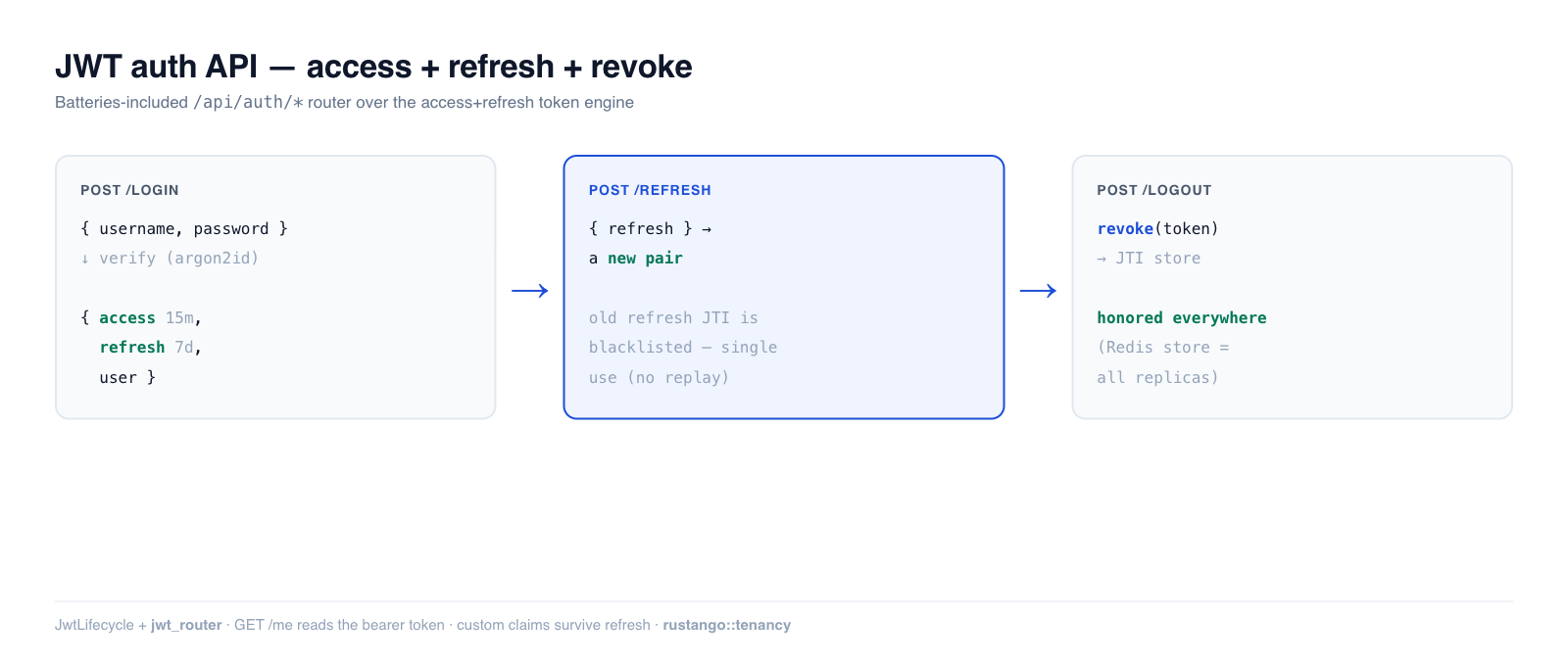
ships that as JwtLifecycle — and a batteries-included router that mounts
POST /api/auth/login, /refresh, /logout, and GET /me for you.
Source:
rustango::tenancy::jwt_lifecycle(JwtLifecycle,JwtTokenPair,JwtClaims) andrustango::tenancy::auth_routes(jwt_router,Config) +rustango::jti_store(JtiStore,InMemoryJtiStore) — behindjwt+tenancy.Runnable version: the token engine is covered by the tested
auth_demo—cargo test -p auth_demo --test auth_jwt_api. The HTTP endpoints are tenant-scoped and exercised end-to-end by the framework's owncrates/rustango/tests/tenant_auth_live.rs.
New to a term here? access/refresh token, rotation, revocation — see the glossary.
Deep dive companion to the Security guide's "Issuing and refreshing JWTs" section. For a single, manually-managed token instead, see JWT (standalone).
Table of contents
- The built-in router · Wiring it up
- The token engine · Refresh & rotation
- Revocation & the JTI store · Custom claims
- Notes & limits
The built-in router
jwt_router mounts the standard four endpoints against the per-tenant
rustango_users table — the ~50 lines of login boilerplate every project
otherwise rewrites:
| Method | Path | Body / Auth | Returns |
|---|---|---|---|
| POST | /api/auth/login | {username, password} | {access, refresh, user} |
| POST | /api/auth/refresh | {refresh} | {access, refresh} |
| POST | /api/auth/logout | Authorization: Bearer <access> | 204 (revokes the JTI) |
| GET | /api/auth/me | Authorization: Bearer <access> | {user_id, username, is_superuser} |
Login verifies the password with argon2id, then issues a
pair. Paths, TTLs, and the signing key are configurable via Config.
Wiring it up
use rustango::tenancy::auth_routes::{jwt_router, Config};

rustango::manage::Cli::new()
    .tenancy()
    .api(my_app::urls::api()
        .merge(jwt_router(Config::default())))   // mounts /api/auth/*
    .run()
    .await
Config::default() signs with RUSTANGO_SESSION_SECRET (the same key as the
admin session cookie) and uses 15-min access / 7-day refresh TTLs. Override
prefix, access_ttl_secs, refresh_ttl_secs, or session_secret as needed.
The endpoints run under the tenant context, so mount them in a tenancy app.
# Login → access + refresh
curl -sX POST localhost:8080/api/auth/login \
  -H 'content-type: application/json' \
  -d '{"username":"alice","password":"hunter2hunter"}'

# Call a protected endpoint
curl localhost:8080/api/auth/me -H "Authorization: Bearer $ACCESS"
The token engine (JwtLifecycle)
Under the router sits JwtLifecycle — usable directly if you want the lifecycle
without the built-in HTTP shape:
use rustango::tenancy::jwt_lifecycle::JwtLifecycle;

let jwt = JwtLifecycle::new(secret_32_bytes);

// Login: issue the pair.
let pair = jwt.issue_pair(user_id);
// → pair.access  (short TTL, send in the Authorization header)
// → pair.refresh (long TTL, store in an HttpOnly cookie / secure storage)

// Authenticated request: verify the access token.
match jwt.verify_access(&access) {
    Some(claims) => { /* claims.sub is the user id */ }
    None => { /* 401: invalid, expired, revoked, or wrong type */ }
}
Access and refresh tokens are not interchangeable — verify_access rejects
a refresh token and vice versa, so a stolen short-lived access token can't be
used to mint new ones:
let pair = jwt.issue_pair(42);
assert!(jwt.verify_refresh(&pair.access).is_none());
assert!(jwt.verify_access(&pair.refresh).is_none());
Refresh and rotation
refresh exchanges a valid refresh token for a new pair and blacklists the
old refresh token's JTI — sliding expiry with single-use refresh tokens (replay
of the old one is rejected):
let pair = jwt.issue_pair(7);
let rotated = jwt.refresh(&pair.refresh).expect("refresh ok");
assert_ne!(pair.access, rotated.access);
assert!(jwt.refresh(&pair.refresh).is_none());   // old refresh is now dead
By default refresh preserves the token's custom claims. If permissions may
have changed (role revoked, scope downgraded), use refresh_with(token, new_claims)
to substitute a fresh payload while still blacklisting the old refresh JTI.
Revocation and the JTI store
Each token carries a unique jti. revoke adds it to a blacklist so subsequent
verify_* calls fail until the token would have expired anyway — this is what
POST /api/auth/logout calls:
let pair = jwt.issue_pair(1);
assert!(jwt.revoke(&pair.access));
assert!(jwt.verify_access(&pair.access).is_none());
The blacklist lives in a pluggable JtiStore. The default InMemoryJtiStore is
single-process and loses revocations on restart — fine for one instance. Any
multi-replica deployment MUST install a shared, durable store (Redis / DB) so a
logout on one replica is honored by all:
use rustango::jti_store::{InMemoryJtiStore, JtiStore};
use std::sync::Arc;

let shared: Arc<dyn JtiStore> = Arc::new(InMemoryJtiStore::new()); // swap for Redis in prod
let a = JwtLifecycle::new(secret.clone()).with_jti_store(Arc::clone(&shared));
let b = JwtLifecycle::new(secret).with_jti_store(Arc::clone(&shared));

let pair = a.issue_pair(5);
a.revoke(&pair.access);
assert!(b.verify_access(&pair.access).is_none());   // B sees A's revocation
Without a shared store,
/logoutis best-effort: a revoked token may still be accepted on another replica until its natural expiry. This is the single most important production setting for JWT auth.
Custom claims
Embed roles / tenant / scope directly in the token so verification needs no
DB lookup. Reserved names (sub, exp, jti, typ) are rejected:
let custom = serde_json::json!({ "roles": ["admin"], "tenant": "acme" })
    .as_object().unwrap().clone();
let pair = jwt.issue_pair_with(99, custom)?;

let claims = jwt.verify_access(&pair.access).unwrap();
let roles: Vec<String> = claims.get_custom("roles").unwrap();   // ["admin"]
Custom claims survive refresh (carried onto the new pair) unless you use
refresh_with.
Notes and limits
- Sessions vs JWT vs this: a plain JWT can't be revoked; a
Session is revocable but needs a per-request store lookup;
JwtLifecycleis the middle path — stateless verify, plus a JTI blocklist for the revocations you actually need (logout, rotation). - HTTP endpoints are tenant-scoped.
jwt_routerresolves users via the tenant context +rustango_users; mount it in a.tenancy()app. The token engine (JwtLifecycle) itself has no such requirement. - Pair this with the auth backend chain's
JwtBackendto authenticate arbitrary routes from theAuthorization: Bearerheader. - HS256 signing, 32-byte key floor — same algorithm and constraints as standalone JWT.