 Rustango
 Auth backends
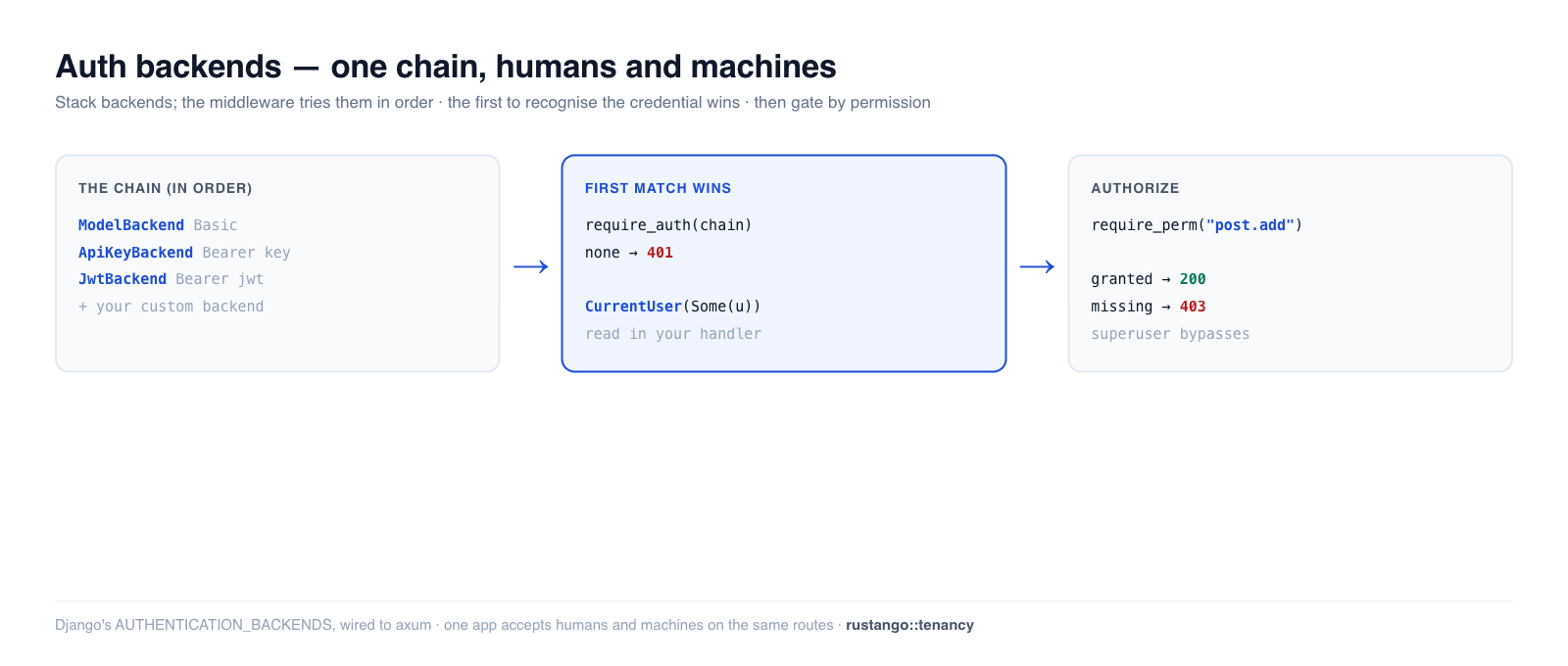
An auth backend answers one question: given an incoming request, who is the
user? Rustango lets you stack several — HTTP Basic, API key, JWT — into a
chain that the auth middleware tries in order, so one app can accept humans and
machines on the same routes. This is Django's AUTHENTICATION_BACKENDS idea,
wired to axum. Pair it with require_auth / require_perm to gate routes and
the CurrentUser extractor to read the result.
New to a term here? Backend, middleware, extractor, permission codename — see the glossary.
Source:
rustango::tenancy::auth_backends(AuthBackend,ModelBackend,ApiKeyBackend,JwtBackend,AuthUser,AuthError) andrustango::tenancy::{RouterAuthExt, CurrentUser}— behind thetenancyfeature. A portable, DB-agnostic registry also lives atrustango::auth_backends(always compiled).Runnable version: every snippet is copied from
auth_backends_doc.rs(cargo test -p rustango --features sqlite,tenancy --test auth_backends_doc).
Table of contents
- The chain · The built-in backends
- Gating routes: require_auth
- Reading the user: CurrentUser
- Permissions: require_perm
- The portable registry
- See also
The chain
You hand require_auth a Vec<Arc<dyn AuthBackend>>. On each request the
middleware tries them in order:
- the first backend that recognises the credential wins (returns the user);
- a backend that doesn't recognise it returns "none" and the next is tried;
- if a backend hard-errors (e.g. an inactive account on a valid token) the chain stops with that error;
- if none match, the request is
401(withrequire_auth) or proceeds anonymously (withoptional_auth).
use std::sync::Arc;
use rustango::tenancy::auth_backends::{ApiKeyBackend, AuthBackend, ModelBackend};

let backends: Vec<Arc<dyn AuthBackend>> = vec![
    Arc::new(ModelBackend),    // HTTP Basic  → humans
    Arc::new(ApiKeyBackend),   // Bearer key  → machines
];
The built-in backends
| Backend | Credential it reads | Identifies a user by |
|---|---|---|
ModelBackend | Authorization: Basic <base64(user:pass)> | username + argon2id password verify against rustango_users |
ApiKeyBackend | Authorization: Bearer <prefix.secret> | the rustango_api_keys table (see API keys) |
JwtBackend | Authorization: Bearer <jwt> | a signed HS256 token (see JWT) |
ApiKeyBackend and JwtBackend both read Bearer and disambiguate by shape (an
API key's first dot-segment is exactly 8 chars). Construct JwtBackend with a
secret of at least 32 bytes (JwtBackend::new(secret) panics otherwise):
use rustango::tenancy::auth_backends::JwtBackend;

let backends: Vec<Arc<dyn AuthBackend>> = vec![
    Arc::new(ModelBackend),
    Arc::new(JwtBackend::new(jwt_secret_at_least_32_bytes.to_vec())),
];
Write a custom backend by implementing the trait (one async method that inspects
the request Parts and returns Option<AuthUser>):
use async_trait::async_trait;   // add `async-trait` to your Cargo.toml
use axum::http::request::Parts;
use rustango::sql::Pool;
use rustango::tenancy::auth_backends::{AuthBackend, AuthError, AuthUser};

struct HeaderBackend;

#[async_trait]
impl AuthBackend for HeaderBackend {
    async fn authenticate(&self, parts: &Parts, _pool: &Pool)
        -> Result<Option<AuthUser>, AuthError>
    {
        // ...inspect parts.headers, return Some(AuthUser{..}) or Ok(None)
        Ok(None)
    }
}
Gating routes: require_auth
RouterAuthExt adds the middleware. require_auth rejects anonymous requests
with 401; optional_auth lets them through (so a handler can branch on
logged-in vs not):
use rustango::tenancy::RouterAuthExt;

let app = Router::new()
    .route("/profile", get(profile))
    .require_auth(backends, pool);     // 401 if no backend matches
Verified behaviour:
// no credentials               → 401
// Basic alice:<correct>        → 200
// Basic alice:<wrong>          → 401   (no backend accepted; no enumeration)
// Bearer <valid api key>       → 200
Reading the user: CurrentUser
Handlers read the authenticated user with the CurrentUser extractor. It's
infallible — Some(user) when a backend resolved one, None otherwise:
use rustango::tenancy::CurrentUser;

async fn profile(CurrentUser(user): CurrentUser) -> Response {
    match user {
        Some(u) => format!("hello {}", u.username).into_response(),
        None    => StatusCode::UNAUTHORIZED.into_response(),
    }
}
Foot-gun: because
CurrentUseris infallible, forgettingrequire_authdoesn't fail to compile — every request just seesNone. Behindrequire_auth, anonymous requests are already401'd, souseris alwaysSomethere.
Permissions: require_perm
require_perm gates a route on a permission codename ({table}.{action},
e.g. post.add). Apply it to the inner sub-router and require_auth to the
outer one, so the user is resolved before the permission is checked:
let admin = Router::new()
    .route("/admin", get(admin_only))
    .require_perm("post.add", pool.clone());   // inner: needs the codename

let app = Router::new()
    .route("/profile", get(profile))
    .merge(admin)
    .require_auth(backends, pool);             // outer: resolves the user first
// alice (granted post.add)   → /admin 200
// bob   (authed, no grant)   → /admin 403
// anonymous                  → /admin 401   (auth runs first)
Resolution: a superuser (active) passes everything; a deactivated user
is denied even with grants; an explicit per-user override wins over role grants;
otherwise any role the user holds that grants the codename passes. Grant with
set_user_perm_pool / roles via create_role_pool + assign_role_pool (the
permission tables are created by ensure_tables_pool).
The portable registry
Separately, rustango::auth_backends (note: crate root, not tenancy) is a
small framework-agnostic registry — a Credentials → Principal chain with
its own AuthBackend trait. It has no HTTP/axum glue; use it when you want
Django-style backend pluggability inside your own auth code:
use rustango::auth_backends::{AuthBackendChain, Credentials, RemoteUserBackend};

let chain = AuthBackendChain::new().with(Arc::new(RemoteUserBackend::trust_username()));
let principal = chain.authenticate(&Credentials::remote("alice")).await?;
Same "first success wins / first error stops" semantics as the HTTP chain. For
gating real routes, use the tenancy middleware above.
See also
- API keys and JWT — the credentials
ApiKeyBackend/JwtBackendconsume. - Passwords — the hashing
ModelBackendverifies against. - Access decorators — per-handler
login_required/permission_requiredgating, the decorator-style alternative torequire_auth/require_perm. - Sessions — cookie-based auth for browsers.