 Rustango
 Passwords
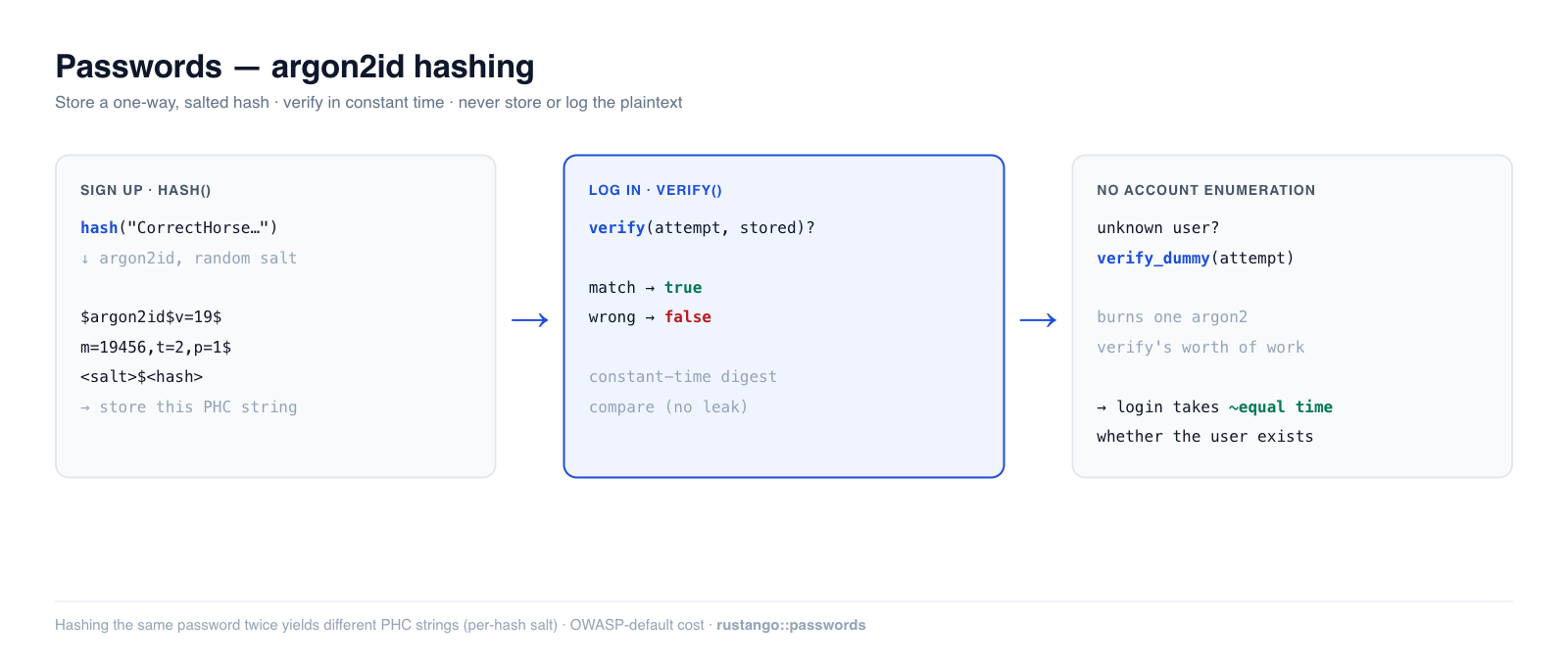
Storing a password means storing something an attacker can't reverse even with
your whole database in hand. Rustango gives you that in two calls — hash
on the way in, verify on the way out — backed by argon2id, the
memory-hard winner of the Password Hashing Competition and the current OWASP
first choice. You never store, log, or compare the plaintext.
Source:
rustango::passwords(hash,verify,verify_dummy,strength_score,StrengthIssue) — behind thepasswordsfeature (on by default). For the tenancy-integrated user-password helpers seerustango::tenancy::password.Runnable version: every snippet below is copied from the tested
auth_demoexample —cargo test -p auth_demo --test auth_passwords.
New to a term here? hash, salt, argon2id, PHC string — see the glossary.
This is the deep dive for the Security guide's "Hashing and checking passwords" section.
Table of contents
- Quick start · Why argon2id
- Hashing on signup · Verifying on login
- Timing-safe logins · Strength checks
- Where the hash lives · Notes & limits
Quick start
use rustango::passwords::{hash, verify};

// Signup — store the returned PHC string, never the plaintext.
let stored: String = hash("CorrectHorseBatteryStaple!42")?;

// Login — check an attempt against the stored hash.
if verify("CorrectHorseBatteryStaple!42", &stored)? {
    // credentials good
}
hash returns a PHC string — a
self-describing line that carries the algorithm, its cost parameters, the random
salt, and the digest:
$argon2id$v=19$m=19456,t=2,p=1$<base64 salt>$<base64 hash>
Because the salt and parameters travel inside the string, verify needs only
the stored value and the attempt — there's no separate salt column to manage.
Why argon2id
hash uses argon2id with OWASP-recommended defaults (m=19 MiB, t=2, p=1).
argon2id is memory-hard: each guess costs real RAM, which is what blunts the
GPU/ASIC farms that make fast hashes (MD5, SHA-256, even bcrypt at low cost)
brute-forceable. Two properties matter for correctness:
-
Salting is automatic and per-hash. Hashing the same password twice yields two different PHC strings, so identical passwords don't collide in your table and precomputed-rainbow-table attacks don't apply.
let a = hash("same-password-12345")?; let b = hash("same-password-12345")?; assert_ne!(a, b); // different random salt each time assert!(verify("same-password-12345", &a)?); assert!(verify("same-password-12345", &b)?); -
Verification is constant-time in the digest comparison (argon2's own
PasswordVerifier), so a byte-by-byte timing leak can't reveal how much of a guess was right.
Hashing on signup
use rustango::passwords::{hash, strength_score};

fn create_user(username: &str, plaintext: &str) -> Result<String, String> {
    // Optional: nudge users away from weak choices (see below).
    let issues = strength_score(plaintext);
    if !issues.is_empty() {
        return Err(format!("password too weak: {issues:?}"));
    }
    // Store the PHC string on the user row (e.g. auth_users.password_hash).
    hash(plaintext).map_err(|e| e.to_string())
}
Verifying on login
use rustango::passwords::verify;

// `stored` is the PHC string you saved at signup.
let ok = verify(attempt, &stored)?;
verify returns:
Ok(true)— the attempt matches.Ok(false)— it doesn't.Err(PasswordError::Verify)—storedwasn't a valid PHC string (a corrupt or truncated column), so treat it as a failed login, not a 500.
Timing-safe logins (account enumeration)
If your login does the expensive verify only when the username exists, an
unknown username returns noticeably faster than a real one — and that timing
gap lets an attacker enumerate valid accounts. verify_dummy closes it: call it
on the user-not-found (and inactive-account) branch so every login spends one
argon2 verify's worth of work regardless.
use rustango::passwords::{verify, verify_dummy};

let row = users::find_by_username(username).await?;
let authenticated = match row {
    Some(u) if u.is_active => verify(attempt, &u.password_hash)?,
    _ => {
        verify_dummy(attempt); // burn the same work, then fail
        false
    }
};
Strength checks
strength_score returns a Vec<StrengthIssue> — empty means "good enough". It's
an intentionally light heuristic to encourage users, not a hard policy gate;
pair it with a breach-list check (HIBP / pwned-passwords) for serious deployments.
use rustango::passwords::{strength_score, StrengthIssue};

assert!(strength_score("Tr0ub4dor&3-CorrectBattery").is_empty());
assert!(strength_score("password123").contains(&StrengthIssue::KnownWeak));
assert!(strength_score("short").contains(&StrengthIssue::TooShort));
StrengthIssue | Triggered when |
|---|---|
TooShort | fewer than 12 characters |
NoDigitsOrSymbols | letters only — no digit or symbol |
NoVariety | only lowercase letters |
KnownWeak | matches the small built-in weak-password list (case-insensitive) |
Where the hash lives
The PHC string is just a String column on whatever account model you own. In
the auth_demo example:
#[derive(Model, Clone, Debug)]
#[rustango(table = "auth_users", display = "username")]
pub struct User {
    #[rustango(primary_key)]
    pub id: Auto<i64>,
    #[rustango(max_length = 150, unique)]
    pub username: String,
    #[rustango(max_length = 254)]
    pub email: String,
    #[rustango(max_length = 255)]      // PHC strings are ~95 chars at these params
    pub password_hash: String,
    pub is_active: bool,
    pub is_superuser: bool,
}
Once the user is authenticated, hand off to a session (for browser apps) or issue a JWT (for APIs).
Notes and limits
- Never store, log, or
==-compare the plaintext.hash→ store;verify→ check. That's the whole contract. - Cost parameters are the OWASP defaults, baked in. They're a sensible floor; raising them later is safe — old hashes still verify (their params live in the PHC string), and you can re-hash on next successful login to upgrade.
strength_scoreis a heuristic, not a policy engine — it won't catchSummer2024!. Layer a breach-list lookup for real strength enforcement.- For multi-tenant apps with the framework's user store, prefer
rustango::tenancy::password(same argon2id, integrated with the tenant user model). This module is the standalone version for apps that own their User table.