 Rustango
 Sessions
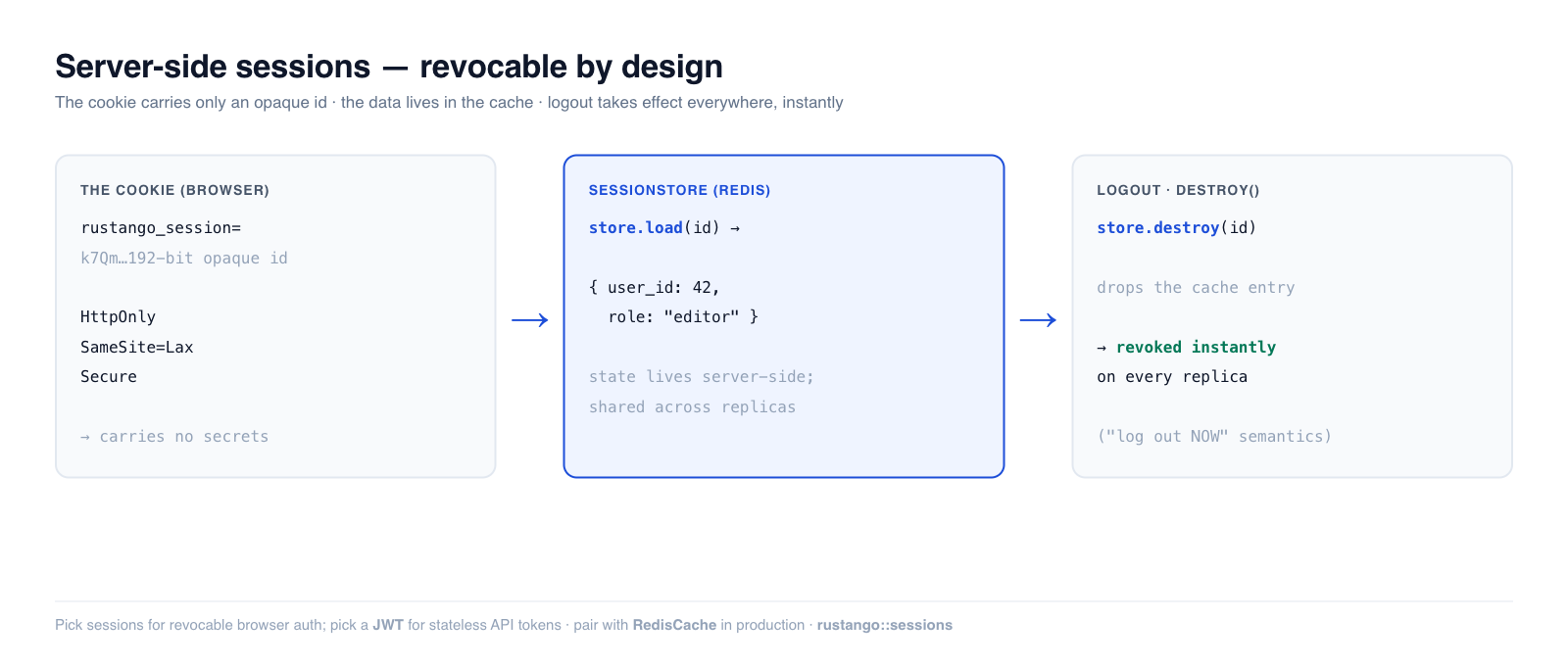
A session keeps a user logged in across requests by handing the browser an
opaque ID in a cookie and keeping everything else server-side. Rustango's
SessionStore puts that state in a cache (Redis in production, in-memory for
tests), so the cookie carries no secrets and a session can be revoked
instantly — delete the entry and every replica sees the logout on the next
request.
Source:
rustango::sessions(Session,SessionStore) +rustango::cache(BoxedCache,InMemoryCache) — behind thesessionsfeature (on by default; pullscache). For a Redis-backed store in production, add thecache-redisfeature (off by default) to getRedisCache.Runnable version: snippets below are copied from the tested
auth_demoexample —cargo test -p auth_demo --test auth_sessions.
New to a term here? session, opaque id, cookie, cache — see the glossary.
Deep dive companion to the Security guide. Gating routes behind a logged-in session is covered in Auth decorators; for stateless API tokens instead, see JWT.
Table of contents
- Quick start · Sessions vs JWT
- The session bag · The cookie
- Picking a backend · Expiry & sliding renewal
- Updating in place · Notes & limits
Quick start
use rustango::sessions::{Session, SessionStore};
use rustango::cache::{BoxedCache, RedisCache};
use std::sync::Arc;

let store = SessionStore::new(Arc::new(RedisCache::new("redis://localhost/0")?) as BoxedCache);

// After the password check (see auth-passwords.md): stash who the user is,
// save → an opaque id, and set that id as the cookie.
let mut session = Session::new();
session.set("user_id", user.id);
let sid = store.save(&session).await?;
// Set-Cookie: rustango_session={sid}; HttpOnly; SameSite=Lax; Secure; Path=/

// On later requests: read the id from the cookie, load the session back.
let session = store.load(&sid).await?.unwrap_or_default();
let user_id: Option<i64> = session.get("user_id");

// Logout: drop the server-side entry — the cookie is now meaningless.
store.destroy(&sid).await?;
The id is 192 bits of OS-CSPRNG randomness, base64url-encoded to 32 chars — well above the 128-bit floor for session tokens, and unguessable.
Sessions vs JWT
Both answer "who is this request?", with opposite trade-offs:
| Session | JWT | |
|---|---|---|
| State | server-side (cache lookup per request) | stateless (self-contained token) |
| Revocation | instant — destroy() the entry | hard — valid until expiry (needs a blocklist) |
| Best for | browser apps, "log this user out NOW" | APIs, service-to-service, no shared store |
Reach for sessions when you need to forcibly log someone out (password change, "sign out all devices", a banned account). Reach for JWT when you want zero per-request lookups and have no shared cache.
The session bag
Session is a typed key→value bag with a dirty bit (so the store can skip a
write when nothing changed):
let mut s = Session::new();
s.set("user_id", 42_i64);            // serialize any Serialize value
s.set("role", "editor");
let uid: Option<i64> = s.get("user_id");   // None if absent or wrong type
s.remove("role");
s.clear();                            // wipe everything (e.g. on logout)
get is fail-soft: a missing key or a value that doesn't deserialize as
the requested type returns None rather than panicking — so a schema change
never 500s a request.
The cookie
The cookie holds only sid. Set it with the security attributes a session
cookie needs:
HttpOnly— JavaScript can't read it (blunts XSS token theft).SameSite=Lax— not sent on cross-site sub-requests (CSRF defense; pair with CSRF tokens for form posts).Secure— HTTPS only (drop only for local HTTP dev).Path=/— visible to the whole app.
Nothing sensitive is in the cookie, so a leaked cookie is exactly as powerful as the session it points at — and you can revoke that server-side at any time.
Picking a backend
SessionStore::new takes any BoxedCache:
RedisCache— production. Shared across replicas, so a login on one instance and a logout on another are both visible everywhere.InMemoryCache— single process / tests. Fast, zero deps, but sessions don't survive a restart and aren't shared between replicas.
use rustango::cache::{BoxedCache, InMemoryCache};
use std::sync::Arc;

// Tests / single-process:
let store = SessionStore::new(Arc::new(InMemoryCache::new()) as BoxedCache);
Expiry and sliding renewal
Sessions default to a 2-week TTL. Override per store, and touch on each
authenticated request for sliding expiration (active users stay logged in,
idle ones age out):
use std::time::Duration;

let store = SessionStore::new(cache).ttl(Duration::from_secs(60 * 60)); // 1 hour

// On each request, after a successful load — extend without rewriting:
store.touch(&sid).await?;   // Ok(false) if the session is already gone
Updating a session in place
save always mints a fresh id (use it at login). To modify an existing session
during a request, load → mutate → save_with_id under the same id:
let mut s = store.load(&sid).await?.unwrap_or_default();
s.set("last_seen", chrono::Utc::now().to_rfc3339());
store.save_with_id(&sid, &s).await?;
Notes and limits
- Revocation is the headline feature —
destroy()(logout) and TTL expiry both take effect on the next request, on every replica sharing the cache. - Corrupt or unknown ids load as
None(fail-open): a cache schema change or a tampered cookie yields an empty session, not an error — the request is simply unauthenticated. - The store doesn't set the cookie for you — it manages server-side state;
you attach/read the
sidcookie in your handler (or via a layer). This keeps it usable from any framework wiring. - Mint a fresh session id on privilege change (e.g. right after login) to
avoid session fixation —
savealready does this since it always generates a new id.