 Rustango
 Middleware
Middleware is code that runs around every request — before your handler
sees it and after it produces a response. It's where cross-cutting concerns
live: logging, rate limiting, security headers, CSRF, locale and timezone
resolution. Rustango ships a deep catalog of ready-made middleware and
makes writing your own a few lines. If you come from Django, this is the
MIDDLEWARE list; from Express, it's app.use(); from Laravel, it's the HTTP
kernel — same idea, attached to your router.
Source: middleware is built on
tower::Layer+axum::middleware::from_fn. Built-ins live acrossrustango::{access_log, rate_limit, cors, security_headers, request_id, …}, plusrustango::forms::csrf(thecsrffeature) andrustango::i18n(middleware::LocaleMiddleware,timezone). Most are on by default.Runnable version: every snippet below is copied from the tested example at
crates/rustango/examples/getting_started_blog/tests/middleware.rs(locale, timezone, security headers, CSRF — all DB-free). Run it withcargo test -p getting_started_blog --test middleware.
New to a term here? Middleware, layer, CSRF, locale — the glossary explains them in plain language.
Table of contents
- How middleware works in Rustango
- Ordering matters
- The built-in catalog
- Locale-aware middleware
- Timezone-aware middleware
- Security headers
- CSRF protection
- Writing your own middleware
- See also
How middleware works in Rustango
There are two shapes, and you'll use both:
-
A
tower::Layer— a reusable, configurable middleware struct. Every built-in is one (SecurityHeadersLayer,RateLimitLayer, …). You attach a layer with axum's.layer(...), or — for most built-ins — with an extension-trait one-liner that reads better:use rustango::security_headers::{SecurityHeadersLayer, SecurityHeadersRouterExt}; // These two are equivalent; the second is the ergonomic form. let app = router.layer(SecurityHeadersLayer::strict()); let app = router.security_headers(SecurityHeadersLayer::strict());Each built-in module exports a
…RouterExttrait (SecurityHeadersRouterExt,RateLimitRouterExt, …). Bring it into scope and you get a.security_headers()/.rate_limit()/.cors()method directly onRouter. That's the idiomatic way to wire a stack:let app = router .request_id(RequestIdLayer::default()) .access_log(AccessLogLayer::default()) .rate_limit(RateLimitLayer::per_ip(60, Duration::from_secs(60))) .cors(CorsLayer::new().allow_origins(vec!["https://app.example.com"])) .security_headers(SecurityHeadersLayer::strict()); -
A function via
axum::middleware::from_fn— the quickest way to write a one-off. You get theRequestand aNext; you callnext.run(req)to continue, and you can do work on either side of that call. The timezone example below is exactly this.
Both compose freely — a from_fn middleware is a layer, so it stacks with
the built-ins in the same .layer(...) chain.
Ordering matters
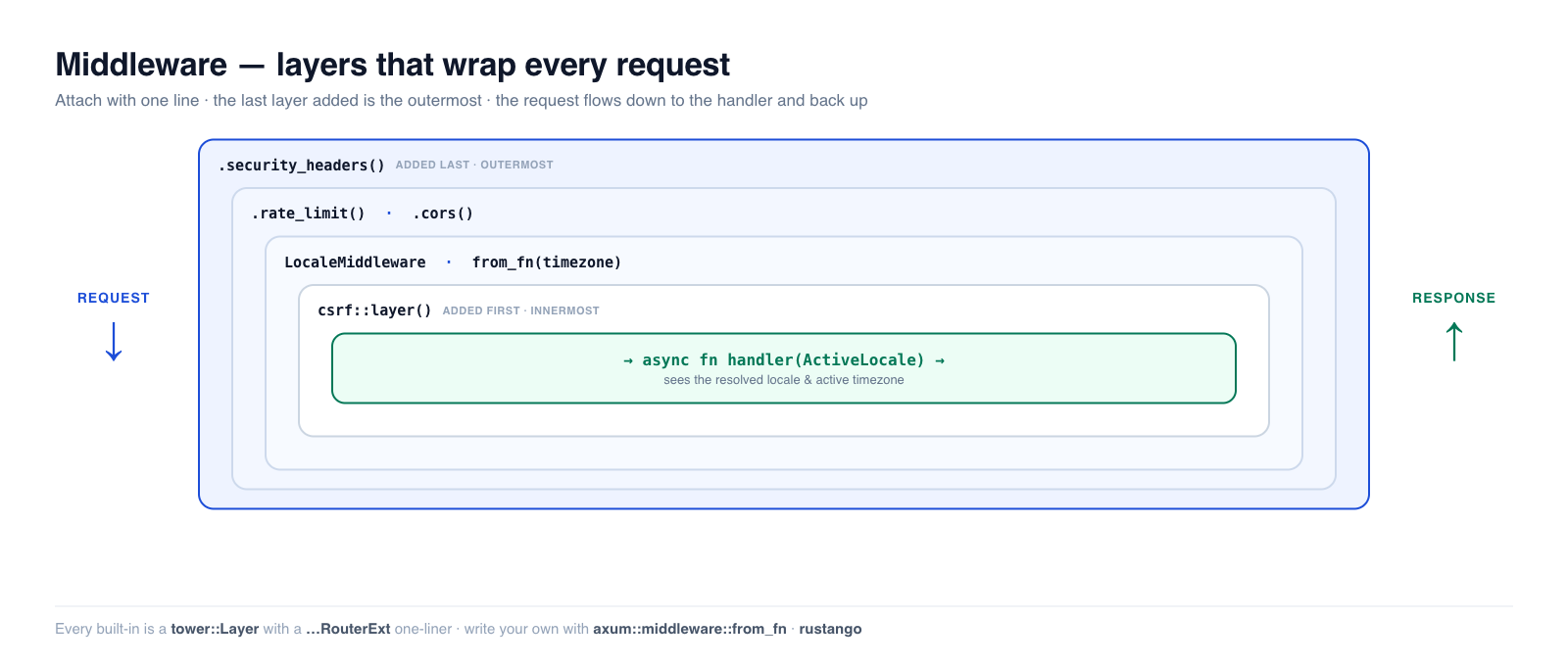
A layer wraps everything added before it, so the last layer you attach is the outermost — it runs first on the way in and last on the way out. Picture the stack as an onion; the request travels down to the handler and the response travels back up:
            ┌──────────────────────────────────────┐
request  →  │ security_headers   (added last = top) │  → response
            │   ┌────────────────────────────────┐  │
            │   │ rate_limit                     │  │
            │   │   ┌──────────────────────────┐ │  │
            │   │   │ request_id (added first) │ │  │
            │   │   │      → handler →         │ │  │
            │   │   └──────────────────────────┘ │  │
            │   └────────────────────────────────┘  │
            └──────────────────────────────────────┘
Practical consequences:
- Put
request_id/access_lognear the bottom (added first) so the correlation id and the log span cover everything that runs after them. - Put rejection-cheap guards near the top (added last) —
allowed_hosts,rate_limit,body_limit— so a blocked request is dropped before it reaches the expensive inner layers. security_headersoutermost so the headers are stamped on every response, including ones short-circuited by an inner layer (a 429, a 403).
The built-in catalog
Every entry is a tower::Layer with a matching …RouterExt one-liner unless
noted. Bring the module's …RouterExt trait into scope to get the method.
| Concern | Layer | Wire it with |
|---|---|---|
| Security & access | ||
| Security headers (HSTS, XFO, CSP…) | SecurityHeadersLayer | .security_headers(..) |
| CSRF (double-submit cookie) | CsrfLayer | .layer(csrf::layer()) |
| CORS | CorsLayer | .cors(..) |
| Host allow-list | AllowedHostsLayer | .allowed_hosts(..) |
| IP allow/block | IpFilterLayer | .ip_filter(..) |
| Force HTTPS | SslRedirectLayer | .ssl_redirect(..) |
| CSP nonce per request | CspNonceLayer | .csp_nonce(..) |
| HMAC request signing | HmacAuthLayer | .layer(..) |
| Traffic & resilience | ||
| Rate limit (per-IP/global) | RateLimitLayer | .rate_limit(..) |
| Distributed rate limit (cache-backed) | CacheRateLimitLayer | .cache_rate_limit(..) |
| Request timeout | RequestTimeoutLayer | .request_timeout(..) |
| Max body size | BodyLimitLayer | .body_limit(..) |
| Maintenance mode (503) | MaintenanceLayer | .maintenance(..) |
| Idempotency keys | IdempotencyLayer | .idempotency(..) |
| Restrict HTTP methods | MethodRestrictLayer | .require_get() / .require_post() / .require_safe() |
| Observability | ||
Request id (X-Request-Id) | RequestIdLayer | .request_id(..) |
| Access log (PII-redacted) | AccessLogLayer | .access_log(..) |
tracing spans | TracingLayer | .layer(..) |
Server-Timing header | ServerTimingLayer | .server_timing(..) |
| Real client IP (behind proxies) | RealIpLayer | .real_ip(..) |
| Content & response | ||
| gzip/br compression | CompressionLayer | .compression(..) |
| ETag / conditional GET | EtagLayer | .etag(..) |
| Trailing-slash redirect | TrailingSlashLayer | .trailing_slash(..) |
| Page caching | CachePageLayer | .layer(..) |
| Localization | ||
| Locale negotiation | LocaleMiddleware | .layer(..) (+ ActiveLocale extractor) |
| Active timezone | (compose with from_fn) | see below |
| Development | ||
| Live reload | LiveReloadLayer | .livereload(..) |
| Debug panel | DebugPanelLayer | .debug_panel(..) |
The next sections walk the ones the request asked for in detail.
Locale-aware middleware
LocaleMiddleware resolves one locale per request and injects it into the
request so any handler can read it. The pick order is Django's: cookie →
Accept-Language → default. The first locale you list is the default unless
you override it.
use rustango::i18n::middleware::{ActiveLocale, LocaleMiddleware};

// First entry is the default; `.default("en")` is explicit here. `ar`
// (Arabic) is included so we can prove the RTL convenience too.
let layer = LocaleMiddleware::new(&["en", "fr", "ar"]).default("en");

let app = Router::new()
    .route(
        "/",
        // The extractor pulls the locale the layer chose for THIS request.
        get(|loc: ActiveLocale| async move { format!("{} {}", loc.0, loc.direction()) }),
    )
    .layer(layer);
Handlers read the result with the ActiveLocale extractor. It's
Infallible — if no middleware ran it falls back to "en" — and it carries
RTL helpers so templates can branch on bidirectionality:
loc.0            // the picked locale, e.g. "fr"
loc.direction()  // "ltr" / "rtl" — feed straight into <html dir="…">
loc.is_rtl()     // true for ar, he, fa, …
The cookie name defaults to django_language (Django-compatible); change it
with .cookie_name("…"), or pass None to disable cookie lookup entirely.
The resolution precedence, verified end-to-end:
// Cookie says fr, Accept-Language says ar → the cookie wins.
//   Cookie: django_language=fr ; Accept-Language: ar   → "fr ltr"
//
// No cookie → negotiate Accept-Language (ar is RTL).
//   Accept-Language: ar,en;q=0.5                        → "ar rtl"
//
// Neither cookie nor a supported language → the default locale.
//   (no headers)                                        → "en ltr"
For URL-prefix locales (/en/about, /fr/about) instead of header
negotiation, mount a sub-router per locale with Router::nest("/fr", …) and
inject the locale there.
Timezone-aware middleware
There is deliberately no timezone layer. Instead the framework gives you a
task-local active offset (rustango::i18n::timezone) and a header/cookie
decoder, and you compose a one-line middleware that activates it — the
canonical "write your own" example. This mirrors Django's USE_TZ=True: store
UTC, render in the user's local clock.
use axum::middleware::{from_fn, Next};
use rustango::i18n::timezone::{current_offset, from_request_headers, with_offset};

/// Per-request middleware: decode the client's UTC offset from the
/// `tz_offset` cookie (or a `Time-Zone:` header), then run the rest of the
/// stack with that offset active so `current_offset()` / the `localtime`
/// Tera filter see it. Falls back to UTC when nothing parseable is sent.
async fn timezone_mw(req: Request<Body>, next: Next) -> Response {
    match from_request_headers(req.headers(), "tz_offset") {
        Some(offset) => with_offset(offset, next.run(req)).await,
        None => next.run(req).await,
    }
}

let app = Router::new()
    .route(
        "/now",
        // The handler runs inside the activated scope, so the task-local
        // offset is visible here (and inside any `.await` it makes).
        get(|| async { current_offset().local_minus_utc().to_string() }),
    )
    .layer(from_fn(timezone_mw));
with_offset installs the offset in a tokio::task_local, so it survives
.await points and thread hops within the request — unlike a thread-local, it
won't vanish when tokio reschedules the task. Inside the scope:
current_offset()returns the activeFixedOffset(UTC outside any scope),localtime(utc_dt)converts a stored UTCDateTimeto it,- the
{{ ts | localtime }}Tera filter (register withtimezone::register_filters) renders in it automatically.
from_request_headers accepts the tz_offset cookie first, then a
Time-Zone: (or X-Timezone:) header. The accepted formats are flexible —
"+05:30", "+0530", "Z"/"UTC", or signed integer minutes ("330",
"-300"), the shape JS's Date.getTimezoneOffset() produces. The cookie is
typically set by a tiny snippet on page load:
<script>
  // getTimezoneOffset() is positive west-of-UTC, so flip the sign.
  const minutes = -new Date().getTimezoneOffset();
  document.cookie = `tz_offset=${minutes};path=/;max-age=31536000`;
</script>
Behavior, verified:
// Cookie: tz_offset=330  (UTC+05:30)   → current_offset() = +19800s
// Header: Time-Zone: -300 (UTC-05:00)  → current_offset() = -18000s
// nothing sent                          → current_offset() = 0 (UTC)
Note —
FixedOffset, not IANA. This models the active timezone as a fixed offset, which is everything a single point in time needs and avoids the ~3 MBchrono-tzdatabase. It does not handle DST transitions. For full IANA support, parse the user'sTzwithchrono-tzat request time and passtz.offset_from_utc_datetime(...)intowith_offset— the middleware shape above is unchanged.
Security headers
SecurityHeadersLayer stamps the standard browser-hardening headers — HSTS,
X-Frame-Options, X-Content-Type-Options, Referrer-Policy, and an optional
Content-Security-Policy — onto every response, in one line.
use rustango::security_headers::{CspBuilder, SecurityHeadersLayer, SecurityHeadersRouterExt};

let app = Router::new()
    .route("/", get(|| async { "ok" }))
    .security_headers(SecurityHeadersLayer::strict().csp(CspBuilder::strict_starter().build()));
That hardens every response:
// strict-transport-security: max-age=31536000; includeSubDomains; preload
// x-content-type-options:     nosniff
// x-frame-options:            DENY
// content-security-policy:    <built from CspBuilder::strict_starter()>
Three presets cover the common cases:
| Preset | Use for | HSTS | X-Frame-Options |
|---|---|---|---|
strict() | production | 1 year + preload | DENY |
relaxed() | embeddable pages | 1 year | SAMEORIGIN |
dev() | local dev | (omitted) | — |
Use dev() locally — HSTS would otherwise pin your browser to HTTPS for a year
on localhost. Build a CSP fluently with CspBuilder (.default_src(..),
.script_src(..), …, .build()), and roll it out safely with
.csp_report_only(true) + .csp_report_uri("/csp-report") before enforcing.
CSRF protection
CSRF (cross-site request forgery) is when another site tricks a logged-in
user's browser into submitting to your app. Rustango defends with the
double-submit-cookie pattern, in rustango::forms::csrf (behind the csrf
feature, turned on automatically by admin).
use rustango::forms::csrf;

let app = Router::new()
    .route("/form", get(|| async { "render form" }))
    .route("/submit", post(|| async { "accepted" }))
    .layer(csrf::layer());
A safe method (GET/HEAD/OPTIONS) mints a rustango_csrf cookie. An unsafe
method (POST/PUT/PATCH/DELETE) must echo that cookie's value back, either in the
X-CSRF-Token header or the _csrf form field; a mismatch is 403 Forbidden:
// GET /form                            → 200 + Set-Cookie: rustango_csrf=…
//
// POST /submit  (no token)             → 403 Forbidden
//
// POST /submit  with both:
//   Cookie:        rustango_csrf=<t>
//   X-CSRF-Token:  <t>                 → 200 OK   (double-submit matches)
In Tera templates, {{ csrf_token }} gives the raw token and {{ csrf_input }}
a ready-made hidden <input name="_csrf"> — drop one in every form. Override
the cookie/header names or the Secure flag with csrf::with_config(CsrfConfig);
for SPA setups, add .with_trusted_origins([...]) to enable the Origin-header
defense-in-depth check on top of the token. The auto-admin enables CSRF on
every mutation with no opt-out.
Writing your own middleware
You saw the quick form already — the timezone middleware
is a complete from_fn example. Use from_fn whenever the logic is app-specific
and you don't need to configure it:
use axum::middleware::{from_fn, Next};

async fn add_app_version(req: Request<Body>, next: Next) -> Response {
    let mut resp = next.run(req).await;          // run the rest of the stack
    resp.headers_mut()
        .insert("X-App-Version", HeaderValue::from_static(env!("CARGO_PKG_VERSION")));
    resp                                          // …then touch the response
}

let app = router.layer(from_fn(add_app_version));
Reach for a full tower::Layer when the middleware is reusable and
configurable — when you'd ship it as part of a library. The pattern is a small
Layer struct that builds a Service, plus (by convention) a …RouterExt
extension trait for the one-liner. rustango::request_id is the smallest
complete reference to copy:
RequestIdLayer— the configurable layer (::default(),.always_generate()),RequestIdService<S>— wraps the inner service; reads/sets theX-Request-Idheader insidecall,RequestId— aFromRequestPartsextractor so handlers can read the id,RequestIdRouterExt— givesRouter::request_id(layer).
LocaleMiddleware (read in crates/rustango/src/i18n/middleware.rs) is a second
worked example — same four pieces, plus a pure .pick(&req) method that's unit-
testable without spinning up a server. Model new layers on either.
See also
- Security guide — the full defense-in-depth stack and a
deploy-time checklist (
manage check --deploy). - Authentication — auth backends and the
CurrentUsermiddleware build on the same layer mechanism. - URLs & routing — where layers attach to routers and sub-routers.